September 10,2026
7 Essential IT Services Businesses Need in 2026

Modern business IT is no longer simply about fixing computers, maintaining networks, and responding when something goes wrong. In 2026, technology has become a strategic part of how businesses operate, protect their information, serve customers, and compete.
As businesses adopt cloud platforms, automation, AI, remote and hybrid working, and increasingly connected systems, they also need reliable IT services to keep everything running efficiently and securely.
Here are seven essential IT services businesses are increasingly looking for in 2026.
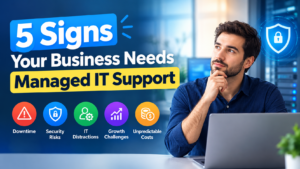
1. Managed IT Support
Reliable IT support remains fundamental to everyday business operations. But businesses increasingly expect more than reactive troubleshooting.
Modern Managed IT Support can include proactive monitoring, help desk assistance, system maintenance, device management, and rapid response when problems arise. This helps businesses minimize disruptions and allows employees to focus on their work instead of technical issues.
For companies without a large internal IT team, managed support can provide access to IT expertise without the cost and complexity of building a full in-house operation.
2. Cyber Security
Cybersecurity has become a business priority, not simply an IT concern. Businesses need to protect systems, customer information, employee accounts, and other critical data from increasingly sophisticated threats.
Modern cybersecurity services can include network protection, access controls, multi-factor authentication, threat monitoring, security assessments, and support with maintaining security best practices.
A strong security strategy also needs to evolve as businesses introduce new cloud services, devices, applications, and remote-working arrangements.
3. Cloud Managed Services
Cloud technology has changed how businesses store data, run applications, and manage IT infrastructure. Many organizations now operate across a combination of cloud, on-premises, and hybrid environments.
Cloud Managed Services can help businesses manage these environments, maintain performance, improve reliability, and make better use of their cloud infrastructure.
Rather than simply moving systems to the cloud and leaving them there, businesses increasingly need ongoing management and optimization to ensure their cloud environment supports their operational goals.
4. Intelligent Automation Services
Manual and repetitive processes can consume valuable employee time and introduce unnecessary errors. Intelligent automation allows businesses to streamline these processes and connect different systems so that routine tasks can happen with less manual intervention.
Automation can be applied to workflows such as data processing, notifications, approvals, reporting, customer interactions, and other repetitive business activities.
The goal is not simply to automate for the sake of automation. Well-designed solutions should reduce unnecessary work, improve efficiency, and allow employees to spend more time on higher-value tasks.
5. Custom Software Development
Off-the-shelf software can meet many business requirements, but it may not always fit specialized workflows or unique operational needs.
Custom Software Development allows businesses to create applications and systems around their specific processes. This can include customer-facing applications, internal business tools, integrations, dashboards, and other software designed to solve particular business challenges.
As businesses look for more efficient and connected digital workflows, custom software can also help integrate systems that would otherwise operate separately.
6. Data Backup & Recovery
Business data is one of an organization’s most important assets. Hardware failures, human errors, cyberattacks, and other incidents can cause significant disruption if critical information cannot be recovered.
Data Backup & Recovery services help businesses maintain secure copies of important information and establish reliable processes for restoring it when necessary.
Effective backup strategies can include automated backups, secure off-site or cloud storage, regular testing, and recovery planning. The objective is simple: reduce the risk of permanent data loss and minimize downtime when an incident occurs.
7. Fully Managed IT Outsourcing
As IT environments become more complex, some businesses choose to outsource broader IT responsibilities rather than managing everything internally.
Fully Managed IT Outsourcing can provide businesses with an external team responsible for managing and supporting their IT environment. This can give organizations access to specialist expertise while reducing the burden on internal employees.
For growing businesses, outsourcing can also provide a more scalable approach to IT management, allowing them to focus internal resources on their core business.
The Role of IT Is Changing
The biggest change in business IT is the shift from simple maintenance toward strategic capability.
Businesses increasingly need technology that is secure, connected, efficient, and capable of supporting future growth. Managed support keeps operations running, cybersecurity protects the business, cloud services provide flexibility, automation improves efficiency, custom software addresses unique requirements, backup and recovery protect critical data, and IT outsourcing provides broader technical expertise.
Together, these services form an important foundation for modern businesses looking to operate smarter and adapt to changing technology.
See How AxLogicSys Can Support Your Business
AxLogicSys provides focused IT services designed to help businesses stay secure, operate efficiently, and make better use of technology.
From Managed IT Support and Cyber Security to Cloud Managed Services, Intelligent Automation, Custom Software Development, Data Backup & Recovery, and Fully Managed IT Outsourcing, our services are built around the technology needs of modern businesses.
Watch our short video to discover how AxLogicSys can help your business build a stronger, more future-ready IT environment.

Ready to build a stronger, more future-ready business?
Explore our IT services or get in touch with AxLogicSys today.